SSL, domain and uptime monitoring for agencies
Never let a client site lapse.
We check every client's certificates, domains, DNS and uptime, and tell you when an automatic renewal has quietly stopped, usually close to four weeks before the site breaks.
Any public hostname. We connect on port 443, read the certificate and check the chain, like a browser would.
client-site.example:443
22 DAYS- Expires
- 17 Oct 2026
- Days left
- 22
- Issuer
- Let's Encrypt
- Chain
- Trusted
- Renewal
- Overdue
- 47-day ready
- Ready (automated renewal)
Let's Encrypt certificates normally renew with about 30 days left. This one has 22, so auto-renewal has probably stopped. That's the email you want three weeks early.
Specimen. Run a check to see a real one.
01 — Client status pages
Give every client a status page with your name on it.
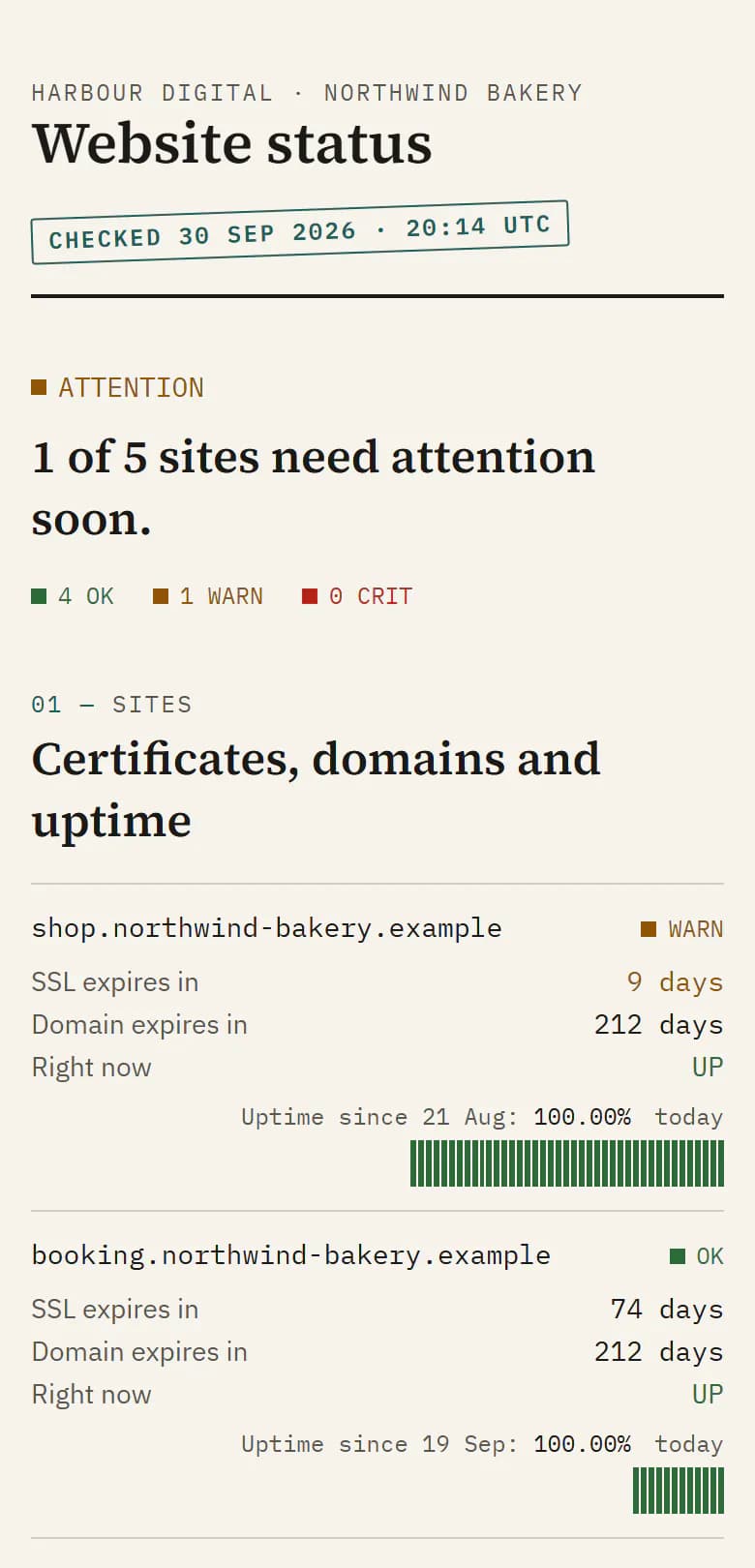
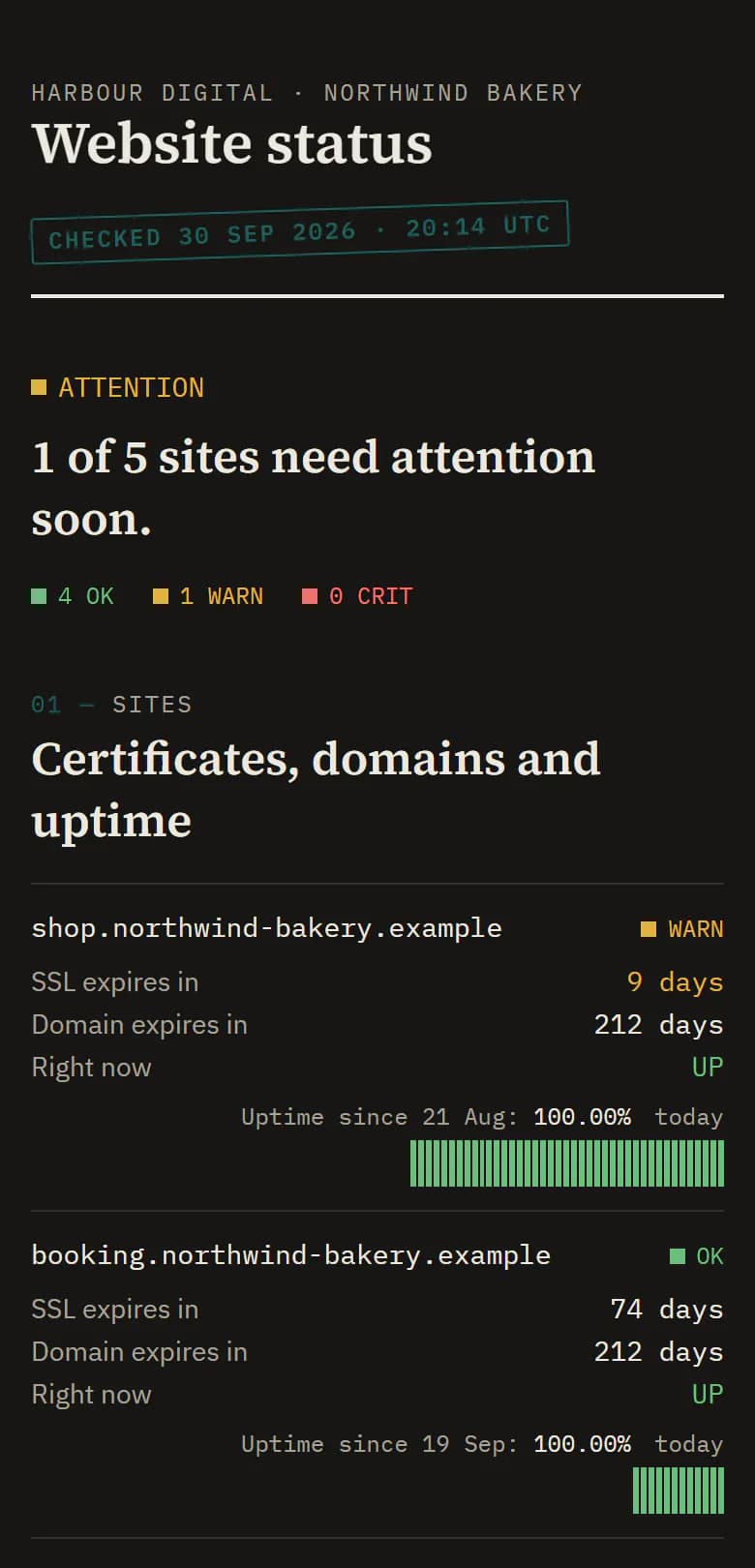
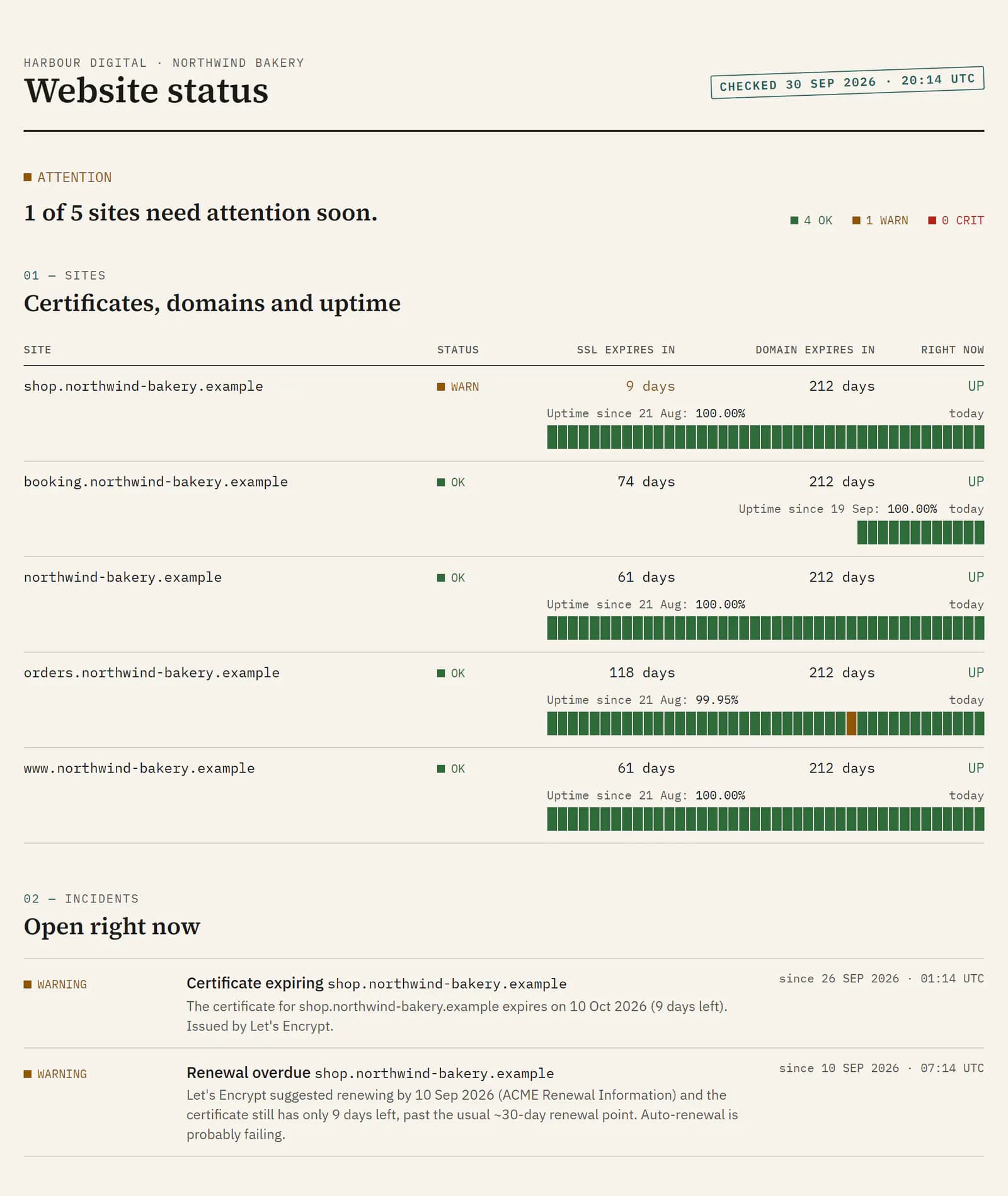
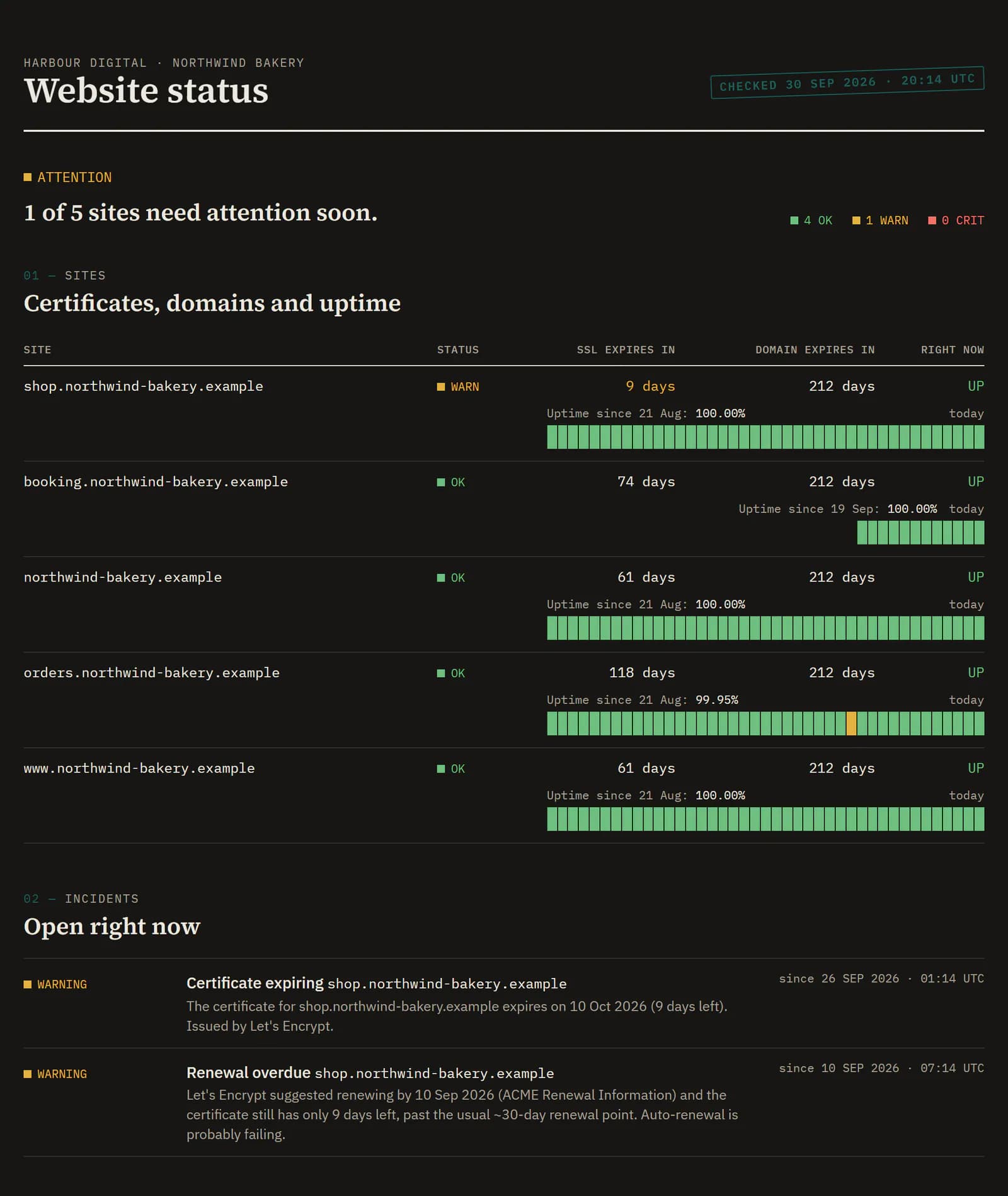
Each client gets one page with their sites on it: when every certificate and domain registration expires, whether each site is up right now, and its uptime day by day. Send them the link and they can check for themselves instead of emailing you to ask.
- Your name on it
- On Agency and Agency Pro the page carries your agency's name, colour and logo, and no mention of us. The logo is linked by URL today; upload is coming soon.
- On the smaller plans
- Free and Freelancer get the same page with a small link to ExpiryOwl at the bottom.
- Where it lives
- Each page has its own /s/ address. Status pages on your own domain (status.youragency.com) with Agency Pro are coming soon.
- In your own site
- Show the same sites inside your client portal with an iframe or a script tag.
02 — The rules changed
Certificates are getting shorter. The reminder emails already stopped.
Browser makers and certificate authorities voted to cut certificate lifetimes from 398 days to 47. Let's Encrypt had already stopped sending expiry emails.
- 4 Jun 2025no emailLet's Encrypt stops sending expiry reminder emails. A stalled renewal now fails silently. source
- Before 15 Mar 2026398daysThe longest a publicly trusted TLS certificate could last. Most paid certificates were sold as "one year". source
- 15 Mar 2026200daysMaximum lifetime dropped to 200 days (CA/Browser Forum Ballot SC-081v3). source
- 15 Mar 2027100daysMaximum lifetime drops to 100 days. Renewing by hand becomes a quarterly job per site. source
- 15 Mar 202947daysMaximum lifetime drops to 47 days. Roughly eight renewals a year for every host you look after. source
Sources: CA/Browser Forum Ballot SC-081v3 (April 2025), Let's Encrypt, “Expiration notification service has ended”. More in our guide to 47-day certificates.
03 — What we do differently
An expiry date is the last thing to go wrong, not the first.
Everyone can count down to an expiry date. The useful warning comes earlier, when the thing that renews the certificate stops working.
- 01
Renewal-failure prediction
Automated certificates renew with about a third of their life left. When one sails past that point, the automation has stopped. We flag it the same day, usually close to four weeks before a 90-day certificate expires. For Let's Encrypt we read the renewal window the CA itself publishes (ARI).
- 02
Subdomain discovery
We search Certificate Transparency logs for every client domain and show the hosts nobody listed: old staging sites, campaign pages, the webmail. One click adds them.
- 03
47-day readiness
Each client gets a score: how many of their certificates renew themselves, and which ones someone still renews by hand. That list is the work to do before March 2027.
- 04
Domain risk, not just expiry
Daily RDAP lookups for expiry, registrar, transfer lock and statuses such as redemption or pending delete, plus alerts when nameservers or MX records change. Some country-code registries (.io, .co, .de, .es and others) don't publish expiry dates over RDAP; for those we show the date as unknown.
- 05
White-label for clients
Group sites by client. Send monthly PDF reports with a short written summary (from Freelancer; with your logo and no mention of us from Agency), and give each client a status page. Status pages on their own domain with Agency Pro are coming soon.
- 06
Lives in your stack
Alerts go where your team already looks: Slack, Teams, Discord, Telegram, email or a signed webhook. Data comes out through an iCal feed, a REST API, an MCP server and an embeddable widget.
- 07
Flat pricing per agency
One price for the whole agency: no per-check, per-page or per-client fees. Agency is $29 a month for 250 domains and unlimited clients.
04 — Lives in your stack
Alerts go where your team already looks.
You shouldn't need another dashboard open all day. Pick the channels, pick the severity for each, and carry on.
| Where | What you get | How |
|---|---|---|
| Slack | Alerts in a channel. A slash command to ask about a client is coming soon | Incoming webhook |
| Microsoft Teams | Alerts as cards in a channel | Incoming webhook / Workflows |
| Discord | Alerts in a channel, coloured by severity | Webhook |
| Telegram | Alerts to a chat or group | Bot message |
| Webhooks | Every incident as signed JSON | HMAC-SHA256 signature header |
| Zapier, Make, n8n | Tickets, sheets, SMS, anything they connect to | Via the signed webhook |
| Calendar | Expiry dates in Google Calendar, Outlook or Apple Calendar | iCal feed URL |
| REST API | Monitors, certificates, domains and incidents as JSON | API keys, read and write |
| MCP server | Ask Claude, Gemini or Cursor about your portfolio | Model Context Protocol |
| Widget | Certificate status inside your own client portal | Script tag or iframe |
| Status pages | A public page per client. On the client's own domain with Agency Pro: coming soon | Hosted page |
05 — Pricing
Priced per agency. No per-check fees.
Add a client's fifteen subdomains without doing sums first.
Compare plans| Plan | Per month | Domains | Clients |
|---|---|---|---|
| Free | $0 | 5 | 1 |
| Freelancer | $9 | 50 | 10 |
| Agency | $29 | 250 | Unlimited |
| Agency Pro | $79 | 1,000 | Unlimited |
Pay yearly and get two months free.
06 — FAQ
Things agencies ask us
Isn't SSL monitoring something my uptime monitor already does?
Most uptime monitors warn you when a certificate is close to expiry. We also tell you when an automated certificate has missed its normal renewal, weeks earlier, and we watch domain registration, DNS changes and the hosts you forgot to add.
My certificates are from Let's Encrypt. Why would I need this?
Because automation fails quietly. A DNS change, a server move or a plugin update can stop renewals, and Let's Encrypt stopped sending expiry reminder emails on 4 June 2025. We notice the missed renewal within six hours.
What happens when certificates are limited to 47 days?
Under CA/Browser Forum Ballot SC-081v3 the maximum certificate lifetime fell to 200 days in March 2026 and falls to 100 days in March 2027 and 47 days in March 2029. Hand-renewed certificates become a constant chore; automated ones need watching because there is less slack when they fail.
How often do you check?
Certificates every 6 hours, domain registration daily (twice a day in the last 30 days), DNS hourly, and uptime every 15 minutes on the free plan down to every 1 minute on Agency Pro.
Is the free plan really free?
Yes. 5 domains, one client, email and chat alerts, no card and no time limit. Paid plans add more domains, clients, seats and white-label reports.
Can my clients see ExpiryOwl?
Only if you want them to. Reports, status pages and the widget carry your name and logo on Agency and Agency Pro. On Free and Freelancer they show a small powered-by line (reports start on Freelancer).
Start with five domains, free.
The free plan watches 5 domains for one client: certificates, domain registration, DNS and uptime every 15 minutes. No card, no trial clock.